Kiewit — 3D Worlds for VR Rigging-Safety Training
We supported ASU's Mesh Labs and Dreamscape teams in Kiewit's investigation of VR for construction-site safety training, building the 3D: rigging scenes rebuilt from site photos and a procedural Blender toolkit that generates whole pipe-rack sites for Unity.
Before a load is lifted on a construction site, someone rigs it: slings, chains, shackles and a hook, set up exactly right. A rigging mistake is easy to miss and costly to learn about for real, because the lesson comes when something falls. Kiewit wanted to know whether virtual reality could teach that judgment instead: put a trainee in front of a lift and ask, is this safe?
Chaotic Curiosity supported Arizona State University's Mesh Labs and Dreamscape teams on that investigation in 2026. Our part was the 3D, in two pieces.
Rigging scenes rebuilt from site photos
The training material starts as photos from real sites, some showing correct practice and some showing a specific fault. We rebuilt those lifts as clean, real-time 3D in Unity: the hook, the slings, the load and the steel around it. Each scenario can then show either a correct rig or a planted fault for the trainee to find.
Getting the details right was the work. Rigging is all small details, like how a chain wraps a beam or where a sling sits in a hook, and we refined them through rounds of feedback from the team.
To get first drafts faster, we also prototyped an image → 3D pipeline. It turns a reference photo of a part into a clean, isolated image of that part, then turns the image into a 3D model.
A whole industrial site, procedurally
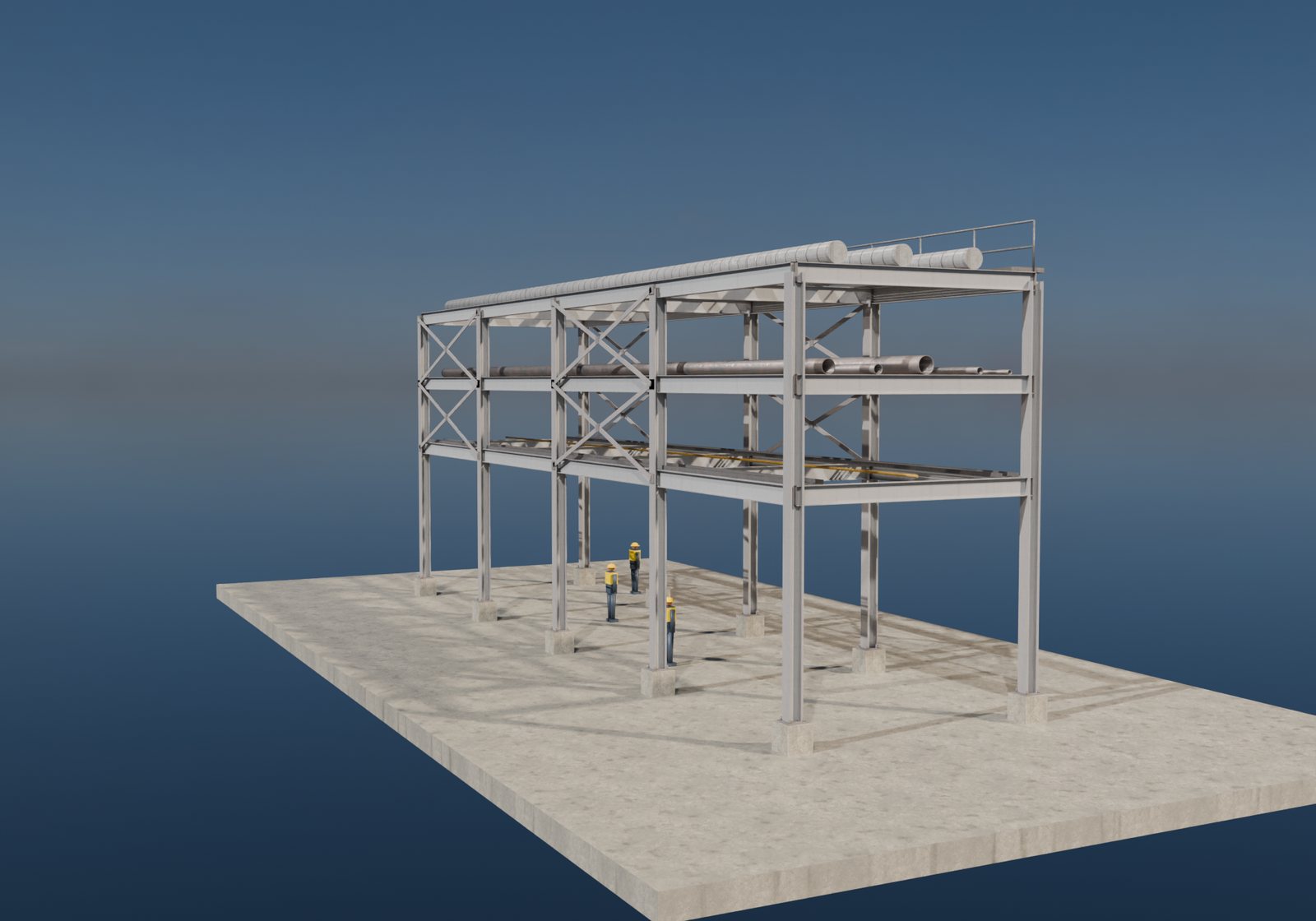
Scenarios need a believable place to happen, and hand-modeling an industrial pipe rack beam by beam is slow. So we built the Industrial Kit, a Blender add-on that generates the site:
- 26 parametric generators covering structural steel, piping, access (grating, handrails, caged ladders, stairs) and equipment. Every part has live sliders for length, diameter, count and spacing.
- A one-click pipe-rack assembly: choose the bays, tiers and clearances and you get a complete, braced, to-scale frame.
- Realistic materials from scanned textures (painted and galvanized steel, insulation cladding, concrete, safety yellow), baked so the look survives the trip into Unity.
- Unity-ready export at true metric scale, as a single drag-in glTF file or as FBX with an import script that wires up the materials automatically.
The defaults aren't guesses. We ran an OpenAI vision pass over the reference photos and site video to produce a component spec, with estimated dimensions, colours and materials for every part in the frame. That spec seeded the kit, and worker figures at true human height let anyone check the scale at a glance.
What it made possible
The team got a toolkit instead of a single model. A request like "make the walkway a little wider" became a slider change instead of a remodel, and the new layout went straight back into Unity. That is what a training investigation needs: change the space, test the scenario, and repeat.